The Art Institute Sketch Kit With Rolling Kary Bag

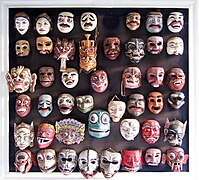
Wood carvings from various parts of Indonesia on display, most notably wayang golek from West Java and Balinese masks and woodcarvings.
It is quite difficult to define Indonesian fine art, since the country is immensely diverse. The sprawling archipelago nation consists of 17.000 islands.[1] Around 922 of those permanently inhabited,[2] by over one,300 ethnic groups,[3] which speak more than 700 living languages.[4]
Republic of indonesia also has experienced a long history, with each menstruation leaves distinctive art. From prehistoric cave paintings and megalithic ancestral statues of Primal Sulawesi, tribal wooden carving traditions of Toraja and Asmat people, graceful Hindu-Buddhist fine art of classical Javanese civilisation which produced Borobudur and Prambanan, vivid Balinese paintings and performing arts, Islamic arts of Aceh, to contemporary arts of modernistic Indonesian artists. Both Indonesian variety and history add to the complexity of defining and identifying what is Indonesian art.[5]
Visual art [edit]
Painting [edit]
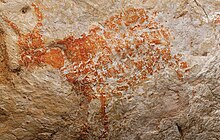
Prehistoric cave paintings were discovered in numbers of sites in Indonesia. The notable ones are those in caves of Maros Regency in South Sulawesi, also in Sangkulirang-Mengkalihat karst germination in East Kutai and Berau Regency in East Kalimantan. The cave paintings was estimated dated from circa 40,000 years old.[half-dozen]

Javanese classical painting, Jaka Tingkir killing a buffalo nether picket of the Sultan of Demak (probably Sultan Trenggana), Anonymous Javanese artist
The art of painting is quite well-adult in Bali, where its people are famed for their artistry. The Balinese art paintings tradition started as classical Kamasan or Wayang style visual narrative, derived from East Javanese visual art discovered on East Javanese candi bas reliefs. Balinese painting tradition is notable for its highly vigorous yet refined intricate art which resembles baroque folk art with tropical themes. Ubud and Butuan in Bali are well known for their paintings. Numbers of painter artists take settled in Bali, which in plow developed the island into a world'southward artists enclave. Balinese painting is also a sought-after drove or souvenir for visitors in Bali.
Modern Indonesian paintings were pioneered by Raden Saleh, a 19th-century Arab-Javanese painter renowned for his romantic-naturalistic piece of work during Dutch Eastward Indies period in Indonesia. A pop genre adult during colonial Dutch E Indies is called Mooi Indie (Dutch for "Beautiful Indies"), which generally capture the romantic scenes of colonial Indies.
Prominent Indonesian painters in 20th century includes Basuki Abdullah, Lee Man Fong, Willem Jan Pieter van der Does, Ida Bagus Made, Dullah, Affandi, Misbach Tamrin, Amrus.
-

Classic painting, depicting the story of Jaratku
-

Pre-1920 Kamasan Palindon Painting detail, an example of Kamasan-way classical painting
Sculpture [edit]

Megalithic sculptures have been discovered in several sites in Republic of indonesia. Afterward, tribal art has flourished within the culture of Nias, Batak, Asmat, Dayak and Toraja. Wood and stone are common materials used as the media for sculpting amid these tribes.
Between the eighth to 15th century, Javanese civilization has developed a refined stone sculpting art and compages which was influenced by Hindu-Buddhist Dharmic civilization. The historic case is the temples of Borobudur and Prambanan. The Shailendra reign of Medang Mataram has produced multiple temples also with its refined sculpture of Hindu and Buddhist deities. A fine case includes the Buddhas epitome of Borobudur with its serene expression, Vairocana flanked by Padmapani and Vajrapani in Mendut temple, also Hindu pantheon of Shiva Mahadewa, Brahma, Vishnu, Ganesha, Durga, Agastya and Nandi in Prambanan temple compound. The Prajnaparamita of Java is a masterpiece of Javanese classical Hindu-Buddhist fine art, created in 13th century Singhasari, Eastward Java.[7]
The art of wood carving is quite well-developed in Indonesia. Other than tribal art woodcarvings of Asmat, Dayak, Nias, and Toraja expanse is well known for its refined wood carving civilization; they are Jepara in Central Coffee, and Bali. Mas hamlet near Ubud in Bali is renowned for their woods etching art. Balinese woodcarving today has a sustained tourist market in Bali.
-
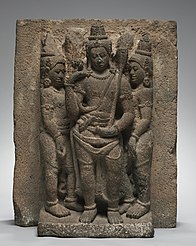
Roro Jonggrang statue; 10th century from Java, Indonesia; Indian and S East Asian Art.
-

Narasimha statue; twelfth century from Java, Indonnesia; Institute for Preservation of Cultural Heritage.
Cinema [edit]
Cinema production in Indonesia was pioneered in 1926 Dutch Eastward Indies moving picture Loetoeng Kasaroeng, a silent moving-picture show which was an adaptation of the Sundanese fable. Indonesian picture industry reached its peak in the 1980s before suffered a significant pass up in both quality and quantity in the 1990s. In the 2000s Indonesian film began to be revived and in the 2010s it became a growing industry; in 2005 Indonesian flick production numbered only 33[8] and in 2014 it increased to 99 films a year.[9] In contempo years Indonesian films, particularly silat fighting activeness genre, has gained worldwide attention. Particularly after the popularity of The Raid serial.
Functional art [edit]
Functional art refers to objects that mainly serve practical purposes. Functional art includes objects related to a homo's essential needs and necessities, such equally clothing, habitation, tools and other useful objects, which are oftentimes decorated and embellished in ways that do not necessarily serve the functional purpose of the object itself. The chief example of daily functional objects that developed into work of arts includes textiles and weavings; wicker objects fabricated from plants fibres; and tools and containers, such as bamboo and rattan weaving. Ane of the most elaborate examples of functional art is the traditional home structures in Indonesian vernacular architecture.
Wicker [edit]

Bamboo weaving, Surabaya c.1906
The need for functional tools and useful things led to creations of various wicker handicrafts; such equally containers, numberless, hats, to cooking and eating utensils. Wooden materials, coconut trounce and plants fibres; such as reed, bamboo and rattan has long been used in traditional weavings in Indonesian traditional lodge to create tools or containers. Examples include woven noken bag created by native Papuans, Sundanese weaved bamboo containers and cooking utensils, to Dayak and Torajan wicker weaved hats.
As the world'south main producer of rattan, Indonesia has quite a well-developed rattan wicker manufacture and local artistry has been encouraged, producing numbers of wicker rattan furniture. Republic of indonesia is also a leading exporter of rattan wicker article of furniture products.
Textile [edit]
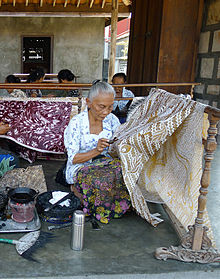
Intricate piece of work of Batik-making in Java
The textiles of Indonesia is diverse; from bawl-material of Eastern Indonesia to intricately woven tenun fabrics from Sumba. Examples of Indonesian textiles includes batik from Java, to songket and ikat developed in many parts of the archipelago.
Batik, which is an art of wax-resist dyeing which creates intricate motifs, was elevated every bit a national art grade—a national costume of Indonesia, which transcends Indonesian ethnic groups. Numbers of patterns and motifs have been developed, especially in Coffee, which contains symbolic meanings and significance. Batik cloth and shirts have been worn as formal attire, as well ofttimes proudly worn equally uniforms. In October 2009, UNESCO designated Indonesian batik as a Masterpiece of Oral and Intangible Heritage of Humanity.[10]
Weaponry [edit]

The kris is an Indonesian asymmetrical dagger with distinctive bract-patterning achieved through alternating laminations of iron and nickelous iron (pamor). The kris is famous for its distinctive wavy blade, although many have direct blades besides. Traditionally worn as a status symbol and carried past warriors for when they lost their master weapon in battle, today it is the main weapon of many martial art styles in Republic of indonesia. Kris is a symbol of ability and of ethnic pride in virtually communities in Indonesian archipelago. Both a weapon and spiritual object, kris are oft considered to accept an essence or presence, considered to possess magical powers, with some blades possessing skilful luck and others possessing bad. Kris are used for display, equally talismans with magical powers, weapons, a sanctified heirloom (pusaka), auxiliary equipment for court soldiers, an accompaniment for ceremonial dress, an indicator of social condition, a symbol of heroism, etc. Legendary kris that possess supernatural power and extraordinary ability were mentioned in traditional folktales.
Other weapons from Indonesia include the parang, golok, kerambit, rencong, celurit, klewang, kujang, and badik.
Pottery [edit]

Javanese Naga (dragon), Kasongan terracotta art, Yogyakarta
Pottery was adult in Indonesia as early on as 400 BCE in Buni civilisation in coastal West Coffee, which produced peculiar pottery with incised, geometrical decorations. It was the first Indian rouletted wares recorded from Southeast Asia.[11] Clay potteries were subsequently developed with evidence plant in Anyer to Cirebon. Artefacts such every bit food and drinkable containers, dated from 400 BC to Advertisement 100 have been institute, mostly as burial gifts.[12]
Circa 13th to 15th century, the Majapahit kingdom developed its terra cotta art. Numerous clay and terracotta artefacts have been discovered, especially from Trowulan, Majapahit's former royal capital letter. Artefacts include figurines, heads figures including male person caput figure which speculated was the portrayal of Gajah Mada, brute figures, among others, are the famous Majapahit piggy bank, various containers, kendi water containers with peculiar breast-similar spout, bas reliefs, flooring and roof tiles, to pipage and architectural ornaments. So far no kiln has been found, which suggests that most of the objects are relatively low fired.[13]
The Majapahit terracotta art probably influenced and was preserved in the Kasongan terracotta art, found in Bantul Regency nigh Yogyakarta and the ane in Bali. Kasongan terracotta is well known for its earthenwares, vases and jars, earthen cooking wares, teapot and cups set, man and animal figurines, such as horses and elephants, also rooster piggy bank. Like earthenware terracotta art also developed in Plered area, nearly Purwakarta in West Coffee.
Architecture [edit]

Rumah gadang, a Minangkabau vernacular house with curved horn-shaped roof
The vernacular compages of Republic of indonesia is diverse and developed co-ordinate to the traditions, history and influences exposure experienced by each culture or society. They are ranged from simple reeds construction of native Papuan, stilted wooden structure with a prominent roof of Tongkonan and Rumah Gadang, to elaborately carved palace of Java and temple compound of Bali.
Performing art [edit]
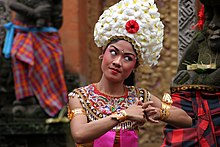
Republic of indonesia has diverse dance traditions, the famous ane is Balinese dance that includes torso, hands and eyes movements.
Performing arts in Republic of indonesia has its root in rituals and as well serves as folks' entertainment. Notable Indonesian performing arts includes ritual dances, dance drama that retelling the ancient epics, legends and stories; also wayang, traditional shadow puppet show.
Dance [edit]
Indonesian dances are tremendously diverse, as each indigenous group has their own dances. This makes total dances in Republic of indonesia are more than than 3,000 Indonesian original dances. The old traditions of dance and drama are being preserved in the many trip the light fantastic schools which flourish not only in the courts simply too in the modernistic, regime-run or supervised fine art academies.[14]
For nomenclature purpose, the dances of Indonesia can be divided according to several aspects. In historical aspect it can exist divided into 3 eras; the prehistoric-tribal era, the Hindu-Buddhist era and the era of Islam. According to its patrons, it can be divided into two genres; court dance and folk trip the light fantastic. In its tradition, Indonesian dances tin can exist divided into two types; traditional trip the light fantastic toe and contemporary trip the light fantastic. Notable Indonesian dances includes Aceh saman; Balinese pendet, legong, barong and kecak; Sundanese jaipongan as well Javanese kuda lumping, ronggeng and reog.
Drama [edit]
Trip the light fantastic toe, drama and traditional music in Indonesia are usually merged equally a whole complete of performing artform. The traditional Indonesian dance drama artforms includes; Malay bangsawan; Minangkabau randai; Balinese gambuh, sanghyang and topeng; Javanese wayang wong, ketoprak and ludruk; Betawi lenong; Sundanese sandiwara; also colonial toneel and komedi stambul.
Wayang [edit]
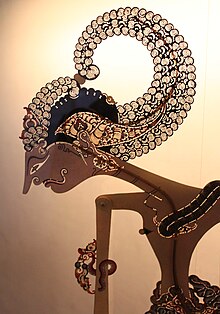
Wayang refer to a theatrical functioning with puppets or human dancers. When the term is used to refer to kinds of puppet theatre, sometimes the puppet itself is referred to as wayang. Performances of shadow boob theatre is known as wayang kulit, are accompanied past a gamelan orchestra in Java, and by gender wayang in Bali. It has been adult into a consummate and refined art form, especially in Coffee and Bali. On vii Nov 2003, UNESCO designated Indonesian wayang kulit equally a Masterpiece of Oral and Intangible Heritage of Humanity.[15] Other wayang artform includes wayang golek and wayang klitik.
Musical art [edit]
Indonesian music is too diverse which uses dissimilar musical instruments. A well-developed, refined, mainly metalophones traditional orchestra can exist discovered in Java and Bali as elaborate gamelan orchestra. Other distinctive musics includes Sundanese angklung and kacapi suling, Minahasan kolintang, Minangkabau talempong, Papuan tifa drum, to East Nusa Tenggara sasando. Indonesian musical genre includes dangdut, campursari, tembang sunda, gambus, to Indonesian rock and pop
Martial art [edit]

Indonesian martial arts include the variety of fighting systems native to or developed in the Indonesian archipelago, both the age-old traditional arts and the more recently adult hybrid combative. Other than physical training, they ofttimes include spiritual aspects to cultivate inner strength, inner peace and college psychological ends.[sixteen] Indonesian martial arts are synonymous with pencak silat.[17] Nevertheless, a number of fighting arts in Indonesia are not included within the category of silat. Pencak silat styles and movements are as various as the Indonesian archipelago itself. Private disciplines can be offensive as in Aceh, evasive as in Bali, or somewhere in between. They may focus on strikes (pukulan), kicks (tendangan), locks (kuncian), weapons (senjata), or even on spiritual evolution rather than physical fighting techniques. Many of Indonesian natives have developed unique martial arts of their own.
Culinary fine art [edit]

A colourful display of Indonesian kue snacks.
Indonesian cuisine is frequently described as vibrant, total of intense flavour.[18] Indonesian cuisine varies greatly past region and has many different influences.[19] Acquired from certain ingredients and bumbu spices mixture. Indonesian dishes have rich flavours; most often described every bit savory, hot and spicy, and also combination of basic tastes such equally sweet, salty, sour and bitter. Sumatran cuisine, for example, frequently has Heart Eastern and Indian influences, featuring curried meat and vegetables such equally gulai and kari, while Javanese cuisine is generally ethnic, with some hint of Chinese influence. The cuisines of Eastern Indonesia are similar to Polynesian and Melanesian cuisine. Elements of Chinese cuisine can be seen in Indonesian cuisine: foods such as bakmi (noodles), bakso (meat or fish assurance), and lumpia (spring rolls) have been completely alloyed.
Some popular Indonesian dishes such as nasi goreng,[20] gado-gado,[21] [22] sate,[23] rendang and soto [24] are ubiquitous in the country and considered as national dishes. The official national dish of Indonesia however, is tumpeng, chosen in 2014 by Indonesian Ministry of Tourism and Creative Economy as the dish that binds the diverseness of Indonesia'south various culinary traditions.
Gallery [edit]
- Indonesian art
-

Asmat totem-like bisj poles
-

-

Nias tribal art statues
-

-

-

A Pair of Loro Blonyo
-

Javanese silverware
-

-

Balinese golden kris hilt, with gems
-

-
-

Gimmicky Balinese wooden sculpture
-
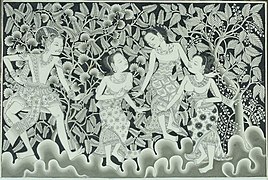
Classic Balinese painting
See also [edit]
- Culture of Indonesia
References [edit]
- ^ (in Indonesian) Dari 17.504 Pulau di Indonesia, 16.056 telah diverifikasi PBB - Eko Prasetya - Merdeka - 19 Agustus 2017
- ^ Based on "Seminar Nasional Penetapan Nama Pulau-pulau Kecil Dalam Presektif Sejarah" or "National Seminary of Name For Little Islands From History Side", sixteen to xviii July 2008 at Palembang, South Sumatra, Indonesia
- ^ "Mengulik Data Suku di Republic of indonesia". Badan Pusat Statistik. 18 November 2015. Retrieved 12 February 2020.
- ^ Lewis, M. Paul (2009). "Ethnologue: Languages of the World, Sixteenth edition". SIL International.
- ^ Indonesia, Aplikasi. "arti indonesia adalah dalam Kamus Besar Bahasa Republic of indonesia KBBI Online". aplikasi-indonesia.com (in Indonesian). Retrieved 2020-12-25 .
- ^ Zimmer, Carl (7 November 2018). "In Cave in Borneo Jungle, Scientists Find Oldest Figurative Painting in the World – A cavern drawing in Borneo is at least 40,000 years old, raising intriguing questions about creativity in ancient societies". The New York Times . Retrieved viii November 2018.
- ^ "Collectionː Prajnaparamita". National Museum of Indonesia. Archived from the original on 2015-01-09. Retrieved 2016-10-01 .
- ^ "Melihat peluang industri film". BBC Indonesia (in Indonesian). 25 January 2010.
- ^ Deden Ramadani (26 May 2014). "Jumlah Bioskop dan Flick Bertambah, Jumlah Penonton Turun". Motion picture Indonesia (in Indonesian).
- ^ ""Indonesian Batik", Inscribed in 2009 on the Representative List of the Intangible Cultural Heritage of Humanity". UNESCO. Archived from the original on 2014-10-12.
- ^ Manguin, Pierre-Yves and Agustijanto Indrajaya. The Archeology of Batujaya (West Java, Indonesia):an Acting Study, in Uncovering Southeast Asia's past.
- ^ Zahorka, Herwig (2007). The Sunda Kingdoms of W Java, From Tarumanagara to Pakuan Pajajaran with the Royal Heart of Bogor. Jakarta: Yayasan Cipta Loka Caraka.
- ^ Soedarmadji J H Darmais, Majapahit Terracotta, 2012, BAB Publishing, ISBN 978-979-8926-29-7
- ^ "The Indonesian Folk Dances". Indonesia Tourism. Archived from the original on 2010-11-24.
- ^ ""Wayang puppet theatre", Inscribed in 2008 (three.COM) on the Representative List of the Intangible Cultural Heritage of Humanity (originally proclaimed in 2003)". UNESCO.
- ^ "Pencak Silat: Techniques and History of the Indonesian Martial Arts". Black Chugalug Magazine. Archived from the original on 2017-09-14. Retrieved 2016-ten-03 .
- ^ Donn F. Draeger (1992). Weapons and fighting arts of Indonesia. Rutland, Vt. : Charles E. Tuttle Co. ISBN978-0-8048-1716-v.
- ^ "About Indonesian food". SBS Australia. 6 September 2013.
- ^ "Indonesian Cuisine". Diner's Digest. Archived from the original on 9 April 2011. Retrieved 11 July 2010.
- ^ "Nasi Goreng: Indonesia'due south mouthwatering national dish". Archived from the original on 6 July 2010. Retrieved 5 July 2010.
- ^ Gado-Gado | Gado-Gado Recipe | Online Indonesian Food and Recipes at IndonesiaEats.com
- ^ "National Dish of Indonesia Gado Gado". Archived from the original on 2010-06-12.
- ^ "Indonesian nutrient recipes: Satay". Archived from the original on 2010-08-12.
- ^ "A Soto Crawl". Eating Asia.
Further reading [edit]
- Tara Sosrowardoyo (1998). Indonesian Fine art. Museum Nasional (Indonesia). Periplus Editions (HK) Express. ISBN9789625933207.
- Koes Karnadi (2006). Modern Indonesian art: from Raden Saleh to the nowadays solar day. Koes Artbooks. ISBN9789798704024.
External links [edit]
- Indonesian Arts, Facts and Details
- Indonesian Visual Arts Archive
Source: https://en.wikipedia.org/wiki/Indonesian_art
0 Response to "The Art Institute Sketch Kit With Rolling Kary Bag"
Post a Comment